The Art of Creation
Stories, imagination, wonder. What we sustain when we invest in Hawaiʻi’s artists and the work they carry forward.
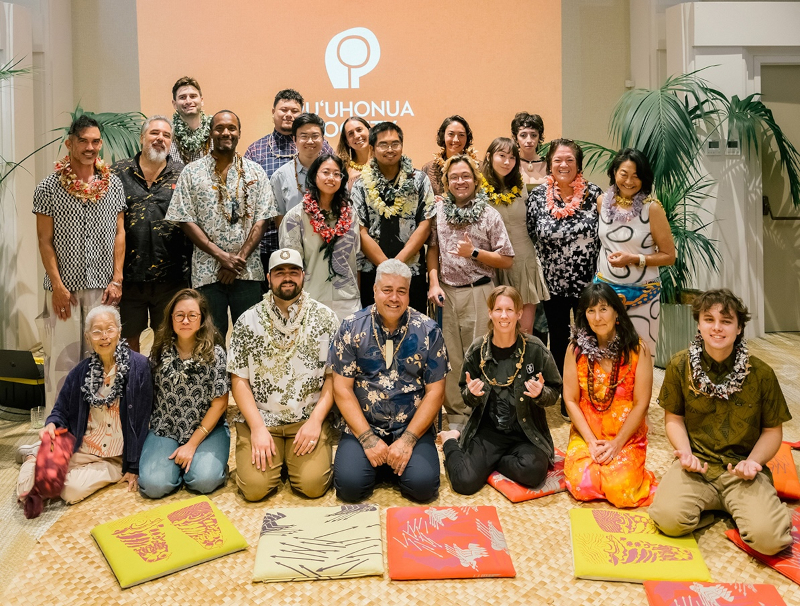 Lila Lee & Pu'uhonua Society | Hoʻākea Source Ho'ike
Long before galleries or even codified language, people created art. Across cultures and centuries, it has remained one of humanity's oldest forms of connection, a conduit for conveying knowledge, expressing identity, and preserving memory. This was true in Hawai‘i as well, where early inhabitants carved figures, symbols, and stories into volcanic stone, leaving vestiges of their lives for future generations they would never meet. Shaped by lineage and shared experience, art has always served as a means of understanding the world, imagining new possibilities, and carrying stories forward. That legacy continues through the artists, cultural practitioners, and communities who keep those traditions alive.
At Hawaiʻi Community Foundation, we believe preserving that legacy requires more than appreciation. It requires action. That means bringing together artists, cultural organizations and community partners to strengthen the relationships that allow creativity and culture to flourish.
This enduring conversation lies at the heart of Hoʻākea Source, a regranting program of Puʻuhonua Society, a nonprofit organization active at the intersections of contemporary art, cultural practice, environmental stewardship, transformational education and community archiving. Named for the expansiveness the grant seeks to acknowledge and create, this Hawaiʻi–wide initiative honors the work of past generations while opening space for new ideas, perspectives and forms of expression.
For Emma Manu-Broderick, executive director of Puʻuhonua Society, art is both an act of inheritance and stewardship. "It's a kohoʻia," she said. "You are choosing, and also you're chosen. You're the continuation of those who came before."
Through a partnership with the Andy Warhol Foundation for the Visual Arts' Regional Regranting Program, and with additional support from the Laila Twigg-Smith Art Fund of the Hawaiʻi Community Foundation (HCF) and the Maxwell/Hanrahan Foundation, Hoʻākea Source recently announced its third hui (cohort) of awardees. The 2026 cohort received grants to support projects spanning photography, animation, printmaking and community-based cinema alongside cultural practices rooted in featherwork, hula kiʻi (Hawaiian puppetry and dance), traditional ʻieʻie basketry, wood carving and ceremony. Guided by the themes of ea (freedoms), puʻuhonua (refuges) and moemoeā (dreams), awardees will spend the coming year exploring how art can help communities remember and reimagine what is possible.
Yet the designated themes are not intended as creative restraints. Rather, they serve as points of departure, encouraging artists to explore new ideas while remaining grounded in community, culture and lived experience.
A Bridge Across Generations
For Maui-based featherworker Enoka Phillips, artistic practice is deeply personal. Introduced to featherwork as a teenager, Phillips learned under the guidance of a mentor who offered him a simple condition before agreeing to teach him: "If I'm going to show you, you need to show someone else."
Years later, this lesson continues to shape Hale ʻUla, Phillips' Hoʻākea Source-supported project inspired by Hale Waiea, a historical Hawaiian artifact. While the project centers on the crafting of a feathered hale (house), its purpose reaches far beyond the structure itself. Through the shared act of creation, participants build relationships between people, place and memory.
Phillips describes featherwork as a spiritual bridge to those who came before. "For me, when you're wearing a feather lei, it's a portal," he said. "It transports you into this state of mind...something that connects me to my ancestors."
Phillips' project reflects a broader philosophy at the heart of Hoʻākea Source. Through deep engagement with a question, story or cultural practice, artists often uncover pathways and possibilities that reach far beyond the work itself.
Art Is a Net, Not a Ladder
Hoʻākea Source program director Donnie Cervantes believes community is the connective force that sustains creative practice. "I was led here through relationships," he said.
This emphasis on relationships also shapes the way Puʻuhonua Society approaches grantmaking. "It's not just about funding an individual artist. It's not about a single ego, a single great idea," Manu-Broderick said.
While art is often seen as a solitary pursuit, Manu-Broderick and Cervantes view creative practice as a living, breathing exchange rooted in human expression and sustained through cultural dialogue across generations. "We are not separate from those that we support," Manu-Broderick said. "If they're going to be making work here, then there's a responsibility to think about the larger ecosystem they are a part of."
In moments of transformation, art often becomes a vehicle for not only reflection but also action. As Manu-Broderick put it, art can be a series of "creative acts of resistance" as well as "creative acts of affirmation."
The impact of these creative acts rarely ends with the work itself. Reflecting on the influence of his mentor Maile Meyer, Manu-Broderick’s mother and a longtime guiding force in the lineage of Puʻuhonua Society, Cervantes described a culture of compassion and wonder that has helped shape the way he works. "I continue to learn as I go. I learn alongside other people and also create that space for other artists to participate in the same process," he said. "That comes from being connected to this family and from the grace and generosity they’ve shown me."
Meyer also introduced Cervantes to the concept of "net thinkers" rather than "ladder thinkers." While ladders imply hierarchy and a straightforward path to individual achievement, nets emphasize reciprocity, interconnectedness and collective growth.
For Cervantes, art in Hawaiʻi can function as a net, allowing resources to permeate throughout community. Like any living ecosystem, it depends on ongoing care and investment to thrive. For cultural practices, stories and creative traditions to endure, the people who carry them must also have the resources to continue their work.
Beyond the Present
"Funding artists really makes tomorrow possible," said artist and cultural practitioner Kauwila Mahi. "Artists are usually the first people to dream of something beyond the present.”
Through support from Hoʻākea Source, Mahi and Malia Osorio are collaborating to develop Kaʻahupāhau, a project rooted in the moʻolelo (story) of the shark kiaʻi (guardian) who protects Puʻuloa, since renamed Pearl Harbor. Through printmaking, storytelling and community gatherings, the project invites participants to engage with questions of justice and collective responsibility. As movement artists grounded in activism, Osorio and Mahi view art not simply as a form of expression, but as a catalyst for reflection and change.
“Our art has a very specific purpose, and it is to incite a sense of understanding that makes you want to change your world,” Osorio said.
Fulfilling that purpose depends on artists having the means to sustain both their practices and their lives.
“The biggest thing, I think, for artists here is the lack of infrastructure,” Osorio said. Beyond project funding, artists need affordable space, materials and the stability to build lasting creative livelihoods in Hawaiʻi.
Through partnerships like Hoʻākea Source, HCF helps connect donor generosity with artists and cultural organizations, ensuring that creators have the resources they need to flourish, not just survive. Because when artists are unable to stay rooted in place, communities risk fraying the thread that ties memory, identity and future generations together.
What would remain if culture, stories and creative expression disappeared? Without them, we lose more than art itself. We lose our imagination, our wonder and our curiosity.
Supporting our artists is an investment in Hawaiʻi as a whole. Their work preserves the stories, knowledge and traditions that connect generations while challenging us to reflect, question and envision new possibilities.
When we give to the arts, we are ultimately investing in what makes us human, remembering who we are and what we wish to be.
Read more Stories of Impact