Rural Puna Strengthens its Collective Kuleana
On Hawai‘i Island, O Maku‘u Ke Kahua and other grassroots organizations are working together to build capacity and create community networks.
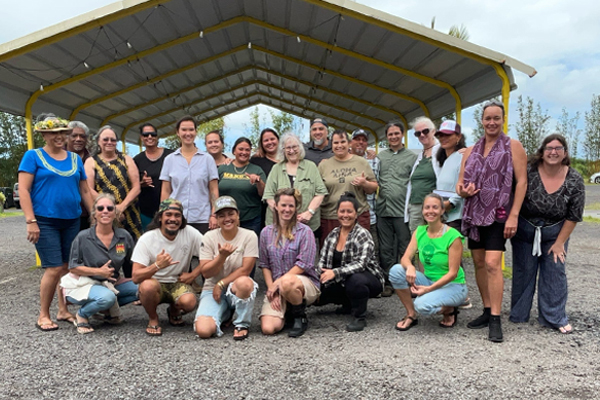
Puna Strong Grantees at a recent cohort gathering.
Over the years, the Maku’u Farmers Market on the East side of Hawai‘i Island has grown into a thriving community institution, attracting people not only from Puna, but all over the island. Encompassing a bustling five-acre open-air marketplace drawing more than 3,000 visitors and 173 vendors offering a diverse array of fresh produce, local crafts, and ‘ono grinds, it creates economic opportunity for local producers, fresh options for shoppers, and a lively gathering place for community.
The market is just one of the programs run by non-profit ‘O Maku‘u Ke Kahua (OMKK), founded by Paula Kekahuna. Today, OMKK is led by Paula’s daughter, executive director Laua‘e Kekahuna.
OMKK’s current success has been a result of hard work and a collaborative approach to problem solving. In 2022, to respond to persistent community needs after the 2018 Kīlauea eruption, which deeply disrupted local families, economies, and cultural practices, OMKK applied to join the Puna Strong Initiative, a partnership between the County of Hawai‘i and the Hawai‘i Community Foundation to assist with disaster readiness and community resilience.
“For the community, they will provide opportunities
to celebrate Hawaiian culture, share knowledge,
and build mutual support networks that can be
activated in times of need.”
- Laua‘e Kekahuna, executive director, ‘O Maku‘u Ke Kahua
Laua‘e says she embraced the opportunity to expand not just her organization’s work of serving families and strengthening community, but her understanding of her personal kūlana (role, position). By applying, she sought to grow OMKK’s capacity to restore food systems; increase the agricultural district’s access to capital, technical support, and markets for farmers; and create space for cultural and social connection.
“Before the Puna Strong Initiative was launched, community organizations in rural Puna often worked in isolation,” says Robbie Ann Kane, HCF program director for the Puna Strong Initiative. “That limited their connectivity to other potential partners and hampered the community’s ability to collectively respond to challenges like the disastrous lava flows from the 2018 Kīlauea eruption.”
Through Puna Strong, Laua‘e and other community leaders received sup-port and training for capacity building, technical assistance, and networking. A transformative face-to-face hui with Kumu Hinaleimoana Wong-Kalu broadened Laua‘e’s understanding of her work. She says it strengthened her commitment to create intentional spaces for connection, cultural practice, and shared learning through in-person gatherings designed to sustain the spirit of connection and collaboration fostered through Puna Strong.
“For our organization, these gatherings will deepen engagement with community members, nurture partnerships, and reinforce our role as a trusted convener,” Laua‘e says. “For the community, they will provide opportunities to celebrate Hawaiian culture, share knowledge, and build mutual support networks that can be activated in times of need.”
You can see the results at both the organizational and community levels. Through capacity building and technical assistance support from Puna Strong, both the Maku‘u Farmers Market and OMKK are thriving and growing. Beyond strengthening her own organization, Laua‘e has become a community connector, building essential networks between community organizations and government that bolster resilience across Puna.
“Stories like Laua‘e’s remind me of the power of place-based philanthropy,” says Robbie Ann. “This approach, drawing from community wisdom and lifting up leaders from those communities, is central to HCF’s work in every sector of our CHANGE Framework.”