Caring for Honouliuli: Conservation, Education and Community in Action
More than 90 endangered species. Nearly 4,000 acres. Inside the high-stakes fight to save Honouliuli.
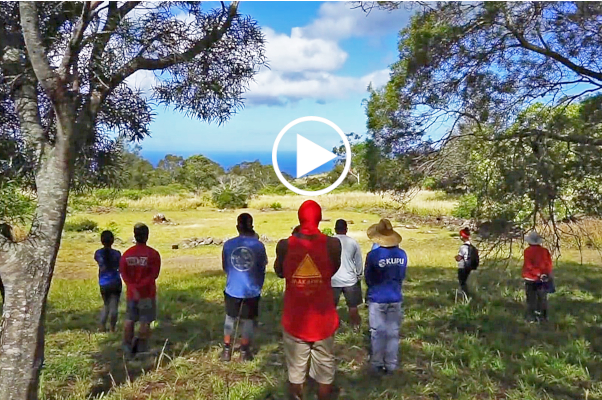
Mālama Learning Center at Honouliuli Forest Reserve video
Before volunteers take a single step into Honouliuli Forest Reserve, they stop to scrub their boots. This simple act is critical in helping prevent invasive species from entering one of O‘ahu’s most ecologically significant areas. For Pauline Sato, co-founder and executive director of Mālama Learning Center (MLC), restoring an entire watershed happens through many small steps like these.
“You can see [Honouliuli] coming from the H-1 freeway going west – that whole section on the southern slope of Wai‘anae – but most people have never visited,” Sato says. “Once you’re up there and you can look across O‘ahu from that vantage point…you understand how it’s all connected. It’s one land, really, with the ocean all around us.”
Protecting this landscape is no simple task. Honouliuli Forest Reserve spans nearly 4,000 acres and multiple landowners and agencies. Restoring the area’s forest ecosystem means navigating more than 90 rare and endangered native plants and animals, managing the invasive species threatening them, and changing environmental conditions.
Strengthening Partnerships Rooted in Stewardship
Bringing together art, science, conservation and culture, MLC designs and offers hands-on, place-based programs focused on environmental education, natural resource management and green career development.
In partnership with the State of Hawai‘i Department of Land and Natural Resources Division of Forestry and Wildlife, the U.S. Army Garrison O‘ahu Natural Resource Program (OANRP), schools, private landowners, and community volunteers help collect seeds, grow plants, restore habitats, and bring people into the largest ahupua‘a (division of land from mountain to coast) on O‘ahu.
Support from HCF helps strengthen the relationships that make long-term coordination possible, while providing the flexibility needed to respond to different challenges. This support might involve clearing fallen trees and debris after a storm, maintaining restoration sites during periods of drought, or expanding opportunities for community members to learn about and care for Honouliuli, whether through site visits or virtual tours.
Facing Growing Environmental Challenges
The risks to Honouliuli are constant and varied. For instance, Kona Low storms this past March brought down trees and caused landslides that resulted in substantial damage across parts of the watershed.
“In my 30 years of working in the Waiʻanae Mountains and Honouliuli, I have never seen an event this damaging,” noted Kapua Kawelo, a HCF Honouliuli Preserve Fund Advisory Committee member and OANRP natural resources manager.
Prolonged drought and wildfire are also persistent threats. Since the devastating Lahaina fires, Sato says many people have a more profound understanding of how quickly fire can transform both communities and native ecosystems.
“The more fires that happen, more invasive species come forward, and the next fire burns bigger and higher up the mountain, endangering more native plants and animals,” she said. “It becomes a chain reaction that’s difficult to stop.”
Connecting People to Place
Responding to these risks means changing how people understand them. Spending time in Honouliuli gives students, volunteers, and visitors direct exposure to the watershed. They clear invasive and fire-prone grasses, establish green firebreaks with moisture-retaining native plants, and tend to nurseries that supply restoration projects throughout the area. For many, this is their first time learning how ecosystems work together from the mountains to the sea, why they matter, and what is at risk.
For those who cannot access Honouliuli in person, MLC has also developed a video project to help reach a wider audience. Supported in part by HCF, the film weaves together fieldwork, cultural knowledge, and reflections from local stakeholders.
“No one will know or care about this place unless they have the same kinds of experiences with nature,” said longtime Pālehua resident Douglas “McD” Philpotts in the video.
Restoration in Honouliuli depends on an ongoing system of relationships among the organizations working together to care for the land. In a place shaped by environmental change and climate pressures, planting and upkeep is as essential as making sure future generations are prepared to care for Honouliuli throughout all the years to come.